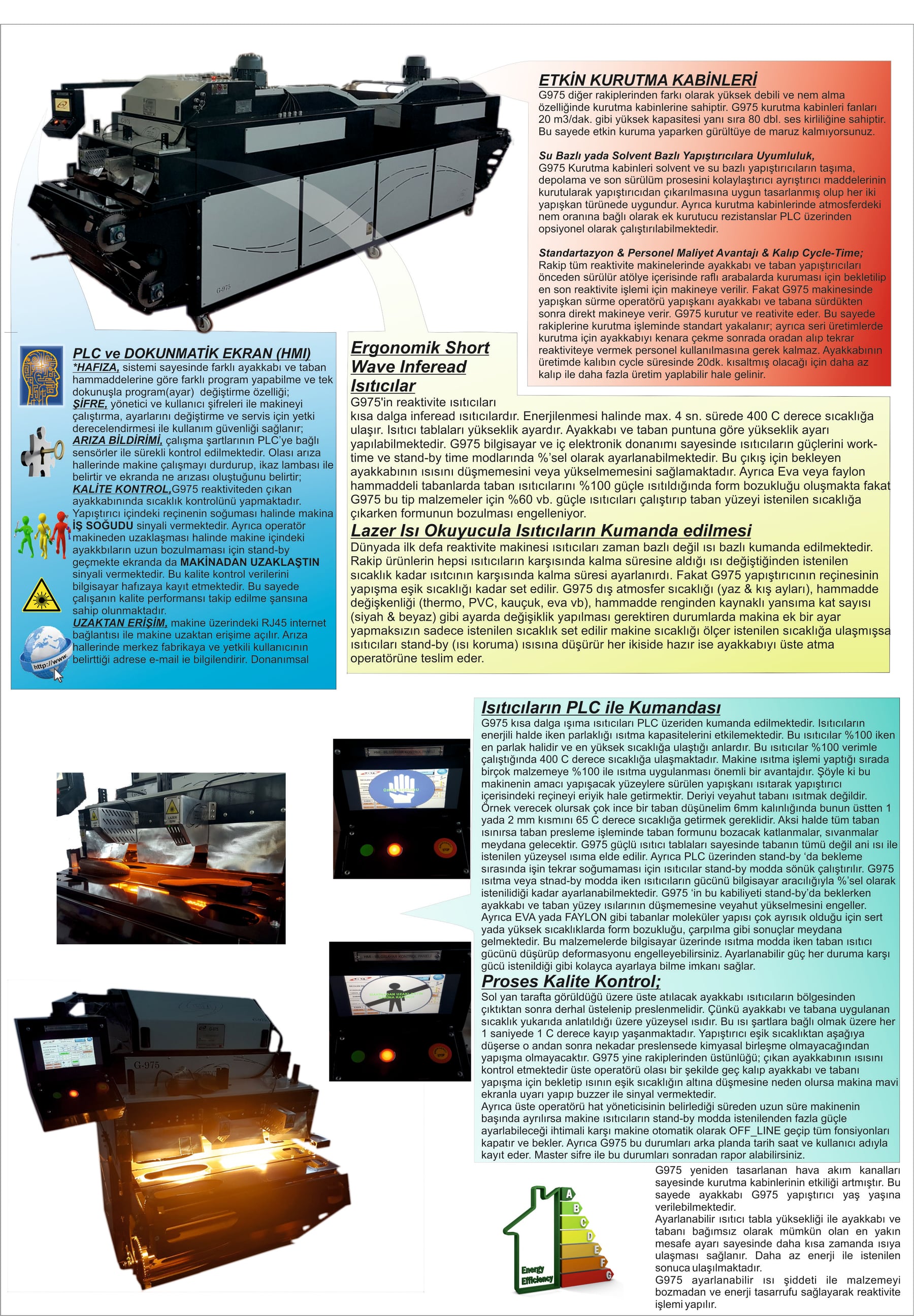
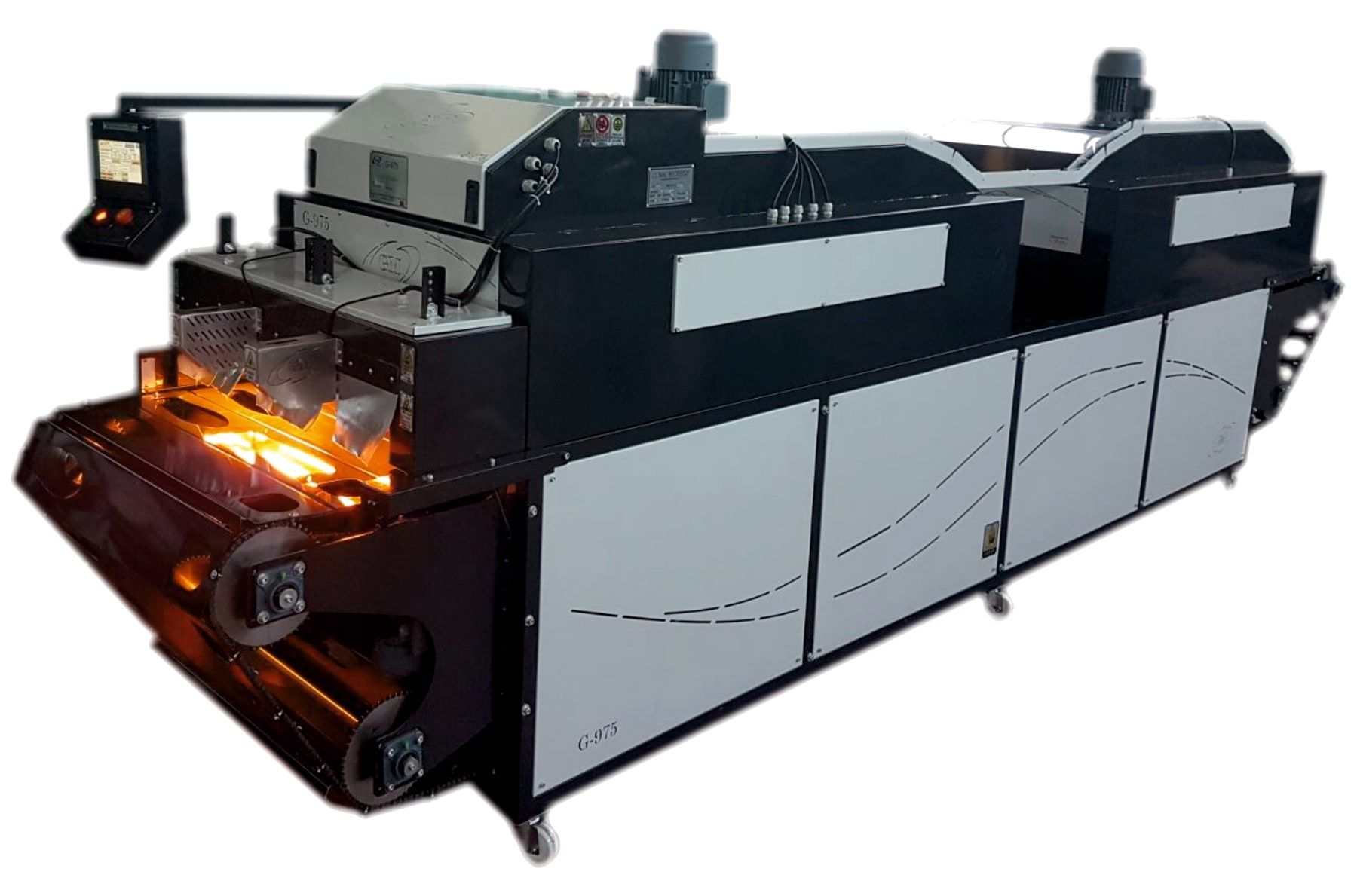
Reactivation
G-975Drying & Reactivation Machine
In a conventional line, shoes and soles wait on racks until the adhesive has dried, and are then reactivated in a separate step. With G-975 the operator applies the adhesive and feeds the parts straight into the machine, which dries and reactivates them in one pass. The heaters are controlled by the measured surface temperature instead of a fixed time, so the adhesive reaches its bonding temperature whatever the season, material or colour.
Request a quote or information

Highlights
- Drying and reactivation in a single machine, with no waiting racks
- Short-wave infrared heaters, controlled by measured surface temperature
- Works with both water-based and solvent-based adhesives
- PLC with touch-screen HMI, stored programs, user levels and fault messages
- Remote access for service over the machine’s network connection
Technical data
| Model | G-975 |
|---|---|
| Dimensions | 100 × 170 × 550 cm |
| Weight | 1200 kg |
| Power consumption | 11 kW |
| Voltage | 380 V AC, 50 Hz |
| Capacity | 1,200 pairs / 10 hours |
Technical data may change with product development. Please contact us for a binding specification.
In detail
Drying and reactivation in one step
In conventional reactivation, shoes and soles are coated with adhesive, left on rack trolleys in the workshop until the adhesive is dry, and only then brought to the machine for reactivation. With G-975 the operator applying the adhesive passes the shoe and sole straight to the machine, which dries and reactivates them.
Drying becomes standardised, no extra staff is needed to move shoes aside to dry and bring them back, and the mould cycle time is 20 minutes shorter, so more pairs can be produced with the same set of lasts.
Drying cabinets
G-975 has drying cabinets with high air flow and dehumidification. The cabinet fans move up to 20 m³/min at a noise level of 80 dB, so drying is effective without exposing operators to noise.
The cabinets are designed to evaporate and extract the carrier substances that make adhesives easier to transport, store and apply, so they suit both water-based and solvent-based adhesives. Depending on the humidity of the air, additional drying heaters can be switched on through the PLC.
Short-wave infrared heaters
The reactivation heaters are short-wave infrared heaters that reach 400 °C within at most 4 seconds of being switched on. The heater tables are height-adjustable to suit the shoe and sole, and the heater power can be set as a percentage separately for work time and stand-by, so a shoe waiting at the exit neither cools down nor overheats.
The aim of reactivation is to melt the resin in the adhesive, not to heat the leather or the sole: of a 6 mm sole, only the top 1–2 mm needs to reach about 65 °C. Heating the whole sole would deform it in the press, causing folds and wrinkles. EVA or Phylon soles deform at full heater power, so the heaters can for example run at 60% and bring the sole surface to the required temperature without damaging it.
Heaters controlled by temperature
In G-975 the reactivation heaters are controlled by temperature rather than by time. In conventional machines, the time the shoe stays under the heater is set. G-975 is set to the bonding threshold temperature of the adhesive: a laser temperature reader measures the surface, and once the required temperature is reached the heaters switch to stand-by and hold the heat.
Changes that would otherwise need a new setting, such as summer and winter temperatures, a different material or a different colour (black or white), need no extra adjustment. When both parts are ready, the machine hands the shoe over to the sole-attaching operator.
Process quality control
A shoe leaving the heater zone must be pressed at once: it loses about 1 °C per second, and if the adhesive falls below its threshold temperature, no chemical bond forms however long it is pressed. G-975 monitors the temperature of the shoe leaving the machine and warns on the screen and with a buzzer if the shoe and sole cool below the threshold before pressing.
If the operator leaves the machine for longer than the line manager has set, the heaters switch to a lower stand-by power and the machine then goes off-line and stops. These events are logged with date, time and user, and reports can be retrieved with the master password.
Efficiency
Redesigned air channels make the drying cabinets more effective, so the shoe can be given to G-975 while the adhesive is still wet. With the adjustable heater table height, shoe and sole can each be brought as close to the heaters as possible and reach the required temperature sooner with less energy, and the adjustable heat intensity reactivates without damaging the material.